Blog Page
5G Multi-Band Small Cells Reference Design
Michael Dalton | Director Systems Marketing | Analog Devices
Ziyao Xu | Sr. Director Product Management | EdgeQ
3 Mar, 2026
NaN mins
Cellular connectivity remains the core service delivered by mobile network operators, evolving generation by generation through successive 3GPP standards. Increasingly, however, operators are being asked to support multiple, distinct applications on the same radio infrastructure, each with different performance and quality of service requirements. Rather than deploying standalone radio units for each application, operators are seeking single radio platforms capable of concurrently supporting multiple services.
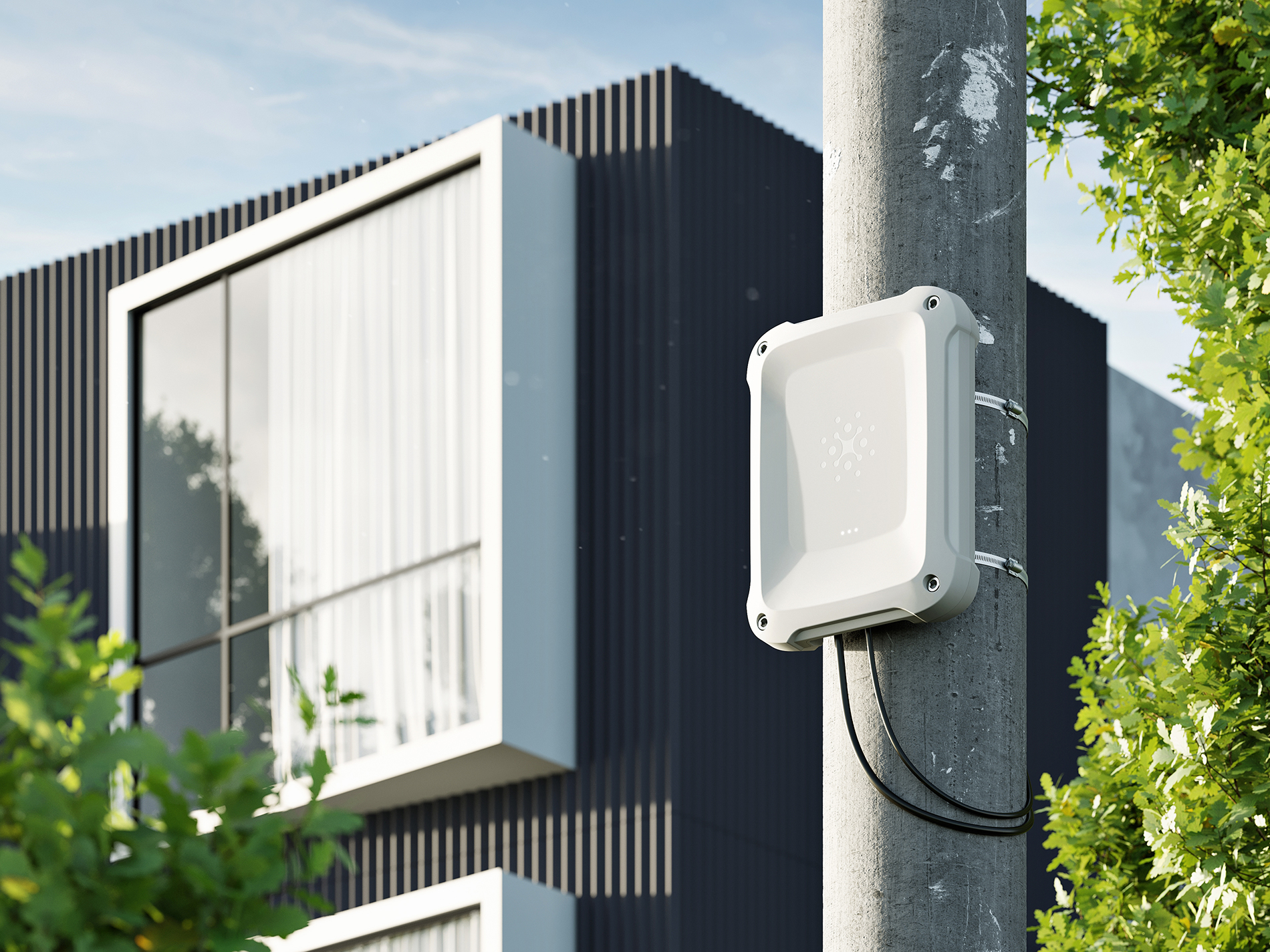
In some cases, one service may rely on LTE while another leverages 5G, with different latency, prioritization, and resilience requirements. Managing these workloads side-by-side simultaneously introduces new architectural demands that go beyond traditional multiband operation. The net result is a growing need for a new class of radio units — compact and lightweight enough for deployment on street furniture such as light poles, yet capable of delivering significantly higher output power and coverage than traditional indoor small cell equipment. These radios must also provide the flexibility, determinism, and processing headroom to support multiple concurrent applications with differing requirements on a single platform.
Packing this level of functionality into a single radio can significantly increase cost and power consumption, leading to larger heat sinks, more complex installation, and difficulties meeting Power over Ethernet budgets.
The joint solution from EdgeQ and Analog Devices, Inc. (ADI) directly addresses these challenges with a fully integrated, all-ASIC architecture that delivers low power consumption at a competitive cost per channel for the RF transceiver.
The solution combines ADI’s Koror ADRV9040 transceiver with the EdgeQ Base Station-on-a-Chip SoC. Koror enables software-defined, multiband RF operation with field-proven performance across all 3GPP bands up to 7.1 GHz. It supports simultaneous multiband DPD capable of linearizing high-power power amplifiers and uses a zero-IF RF architecture, enabling integration of up to four different bands across eight separate RF channels with no interleaving spurs.
For the first time in wireless infrastructure, EdgeQ has compacted the most complex and core functions of the cloud and network into a single chip the size of a coin. The approach is to allow frictionless deployment of private (and public) 5G networks for enterprise environments.
To engineer a chip that can elastically scale to support 6 operators, we ensured it can support 4 component carriers, 4 carrier aggregations for both contiguous and non-contiguous bands. Each of the 4 bands (10/20/30/40 MHz) can operate within 200 MHz for expanded access to both private and public networks with seamless handover across all carriers. By maximizing on more carriers, we can utilize more of the available spectrum in the most extreme environments that require multi-operator support in a neutral-host setting.
By starting with a base physical product (silicon), all differentiations are defined downstream based on a unique firmware upload tagged to a specific customer, feature set, and product nomenclature. A unique software key is assigned between customers and products to ensure clarity, security, and confirmation of delivered product.
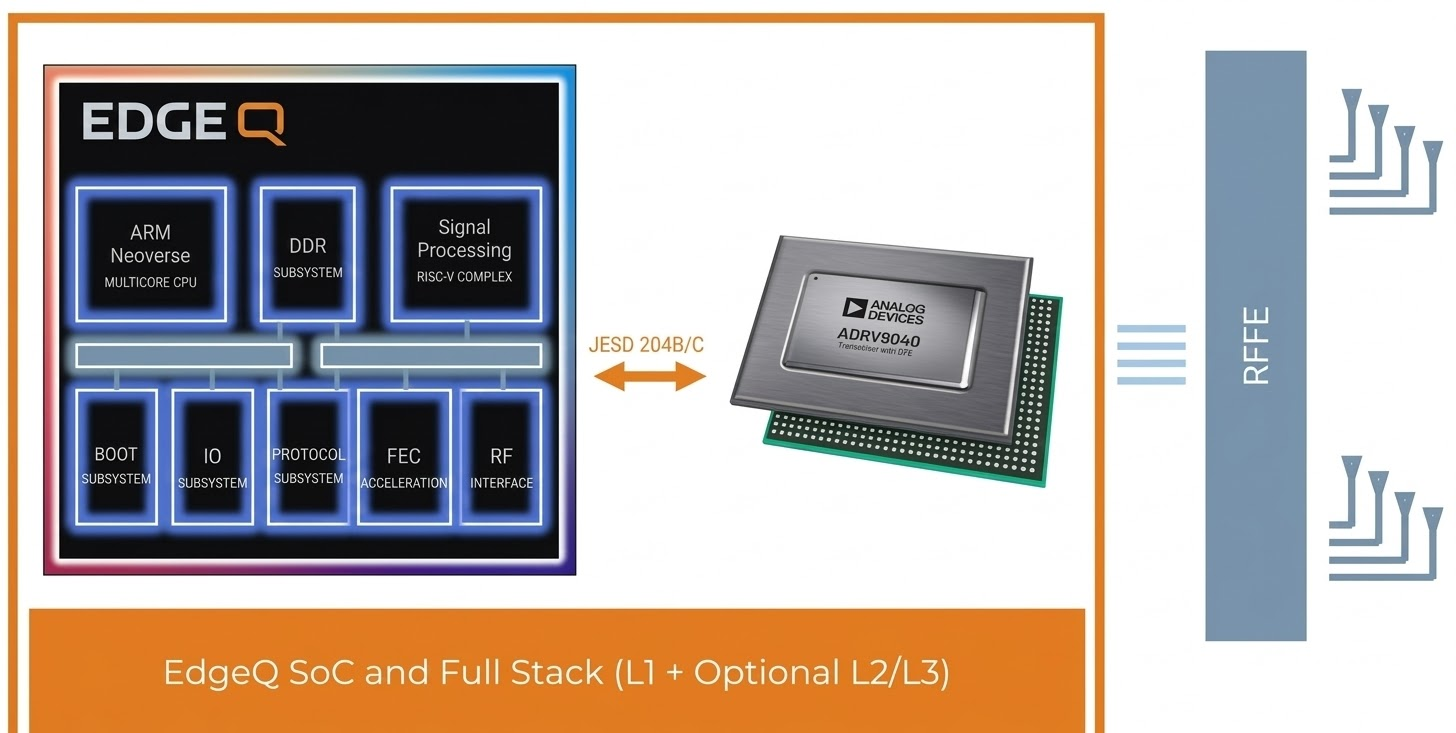
EdgeQ digital SoC paired with ADI’s Koror ADRV9040 transceiver
The EdgeQ and ADI solution is focused on connecting the next billion people and trillions of devices. One application is to harness the combined solution to create ad-hoc mobile networks for emergency public services. Both companies are working to supply a platform solution to a global operator, aiming to stand up critical communication services in times of emergencies, such as natural disasters. Such a solution needs to natively support both 4G and 5G given the long-tail of legacy endpoint equipment out in the field. The solution requires a high-performance digital predistortion (DPD) engine, which maximizes the tradeoff between power efficiency and signal linearity, allowing for cost-effective, high-power, and compact RF systems. This becomes a necessity, as these small-cell solutions need to be portable yet perform like a mini-macro cell.
The EdgeQ-ADI platform also enables enterprises across industries such as manufacturing, automotive, and warehousing to leverage 5G networking to power new applications, intelligent services, and new business models.
- Warehousing/Logistics – create more efficient supply chains via autonomous robotics
- Smart Ports – Combine computer vision and 5G for port automation & worker safety
- Schools – provide wireless and internet access that is easy to scale, secure, and manage from anywhere.
- Satellite – broadband internet for remote locations, maritime/aeronautical/land mobility industries